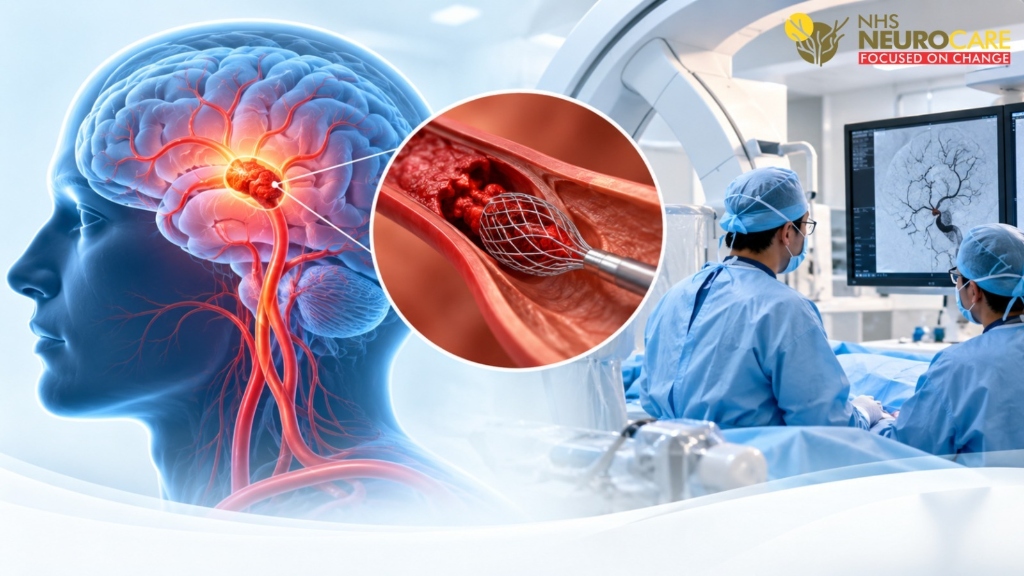
Mechanical Thrombectomy for Stroke: Advanced Clot Removal Treatment When Every Second Counts
Chief Neurologist & Founder Director •
NHS Neurocare, Jalandhar
A stroke can change a life within minutes. When a major blood vessel supplying the brain becomes blocked by a blood clot, millions of brain cells are placed at risk. The faster blood flow can be restored, the greater the opportunity to protect brain tissue and reduce long-term disability.
Mechanical thrombectomy is an advanced, minimally invasive stroke treatment designed to physically remove certain blood clots from large arteries of the brain. For eligible patients with an acute ischaemic stroke caused by a large vessel occlusion (LVO), mechanical thrombectomy can restore blood flow to the affected part of the brain.
At NHS Neurocare, NHS Hospital, Jalandhar, stroke emergencies are managed through a time-sensitive approach supported by neurologists, neurointervention expertise, emergency imaging, critical care and stroke-focused infrastructure.
If someone develops sudden facial weakness, arm or leg weakness, difficulty speaking, loss of balance or vision changes, do not wait for the symptoms to improve. Seek emergency medical attention immediately.
What Is Mechanical Thrombectomy?
Mechanical thrombectomy, also called endovascular thrombectomy (EVT) or clot retrieval, is an emergency procedure used to remove a blood clot blocking a large blood vessel in the brain.
Unlike intravenous thrombolysis, which uses medication to dissolve a clot, mechanical thrombectomy involves reaching the blocked artery through a blood vessel and physically removing or aspirating the clot.
During the procedure, a specialist generally introduces a thin catheter through an artery, commonly from the groin or wrist, and guides it towards the blocked blood vessel using advanced imaging. A specialised device such as a stent retriever or aspiration catheter can then be used to retrieve or remove the clot.
The primary objective is simple but extremely time-sensitive:
Remove the blockage. Restore blood flow. Protect as much brain tissue as possible.
Why Is Mechanical Thrombectomy Used in Stroke?
There are two major categories of stroke:
- Ischaemic stroke: caused by blockage of blood flow to part of the brain.
- Haemorrhagic stroke: caused by bleeding in or around the brain.
Mechanical thrombectomy is primarily used for selected patients with acute ischaemic stroke caused by an eligible large vessel occlusion.
A large clot may block an important artery supplying a significant area of the brain. Without blood flow, brain tissue is deprived of oxygen and nutrients, and irreversible injury can develop.
This is why stroke specialists repeatedly emphasise:
Stroke treatment should never be delayed while waiting to see whether symptoms disappear.
What Is a Large Vessel Occlusion (LVO)?
A large vessel occlusion occurs when one of the major arteries supplying the brain becomes blocked.
Depending on the location of the clot, an LVO may cause severe neurological symptoms such as:
- Sudden weakness or paralysis on one side
- Facial drooping
- Difficulty speaking or understanding speech
- Sudden loss of vision
- Severe imbalance
- Difficulty walking
- Reduced consciousness
- Sudden inability to move an arm or leg
Not every stroke is caused by an LVO, and not every patient with a stroke requires mechanical thrombectomy. Emergency brain and vascular imaging helps the stroke team determine the type of stroke, location of the blockage and appropriate treatment.
Who May Be Eligible for Mechanical Thrombectomy?
Eligibility is determined individually by the stroke and neurointervention team.
Doctors may consider factors including:
- Type of stroke
- Location of the blocked artery
- Severity of neurological symptoms
- Time symptoms started
- Time the patient was last known to be well
- CT or MRI findings
- CT angiography or other vascular imaging
- Amount of brain tissue already affected
- Amount of potentially salvageable brain tissue
- Previous functional status
- Other medical conditions
- Overall clinical condition
Modern stroke treatment therefore depends on much more than simply asking, “How many hours have passed?”
Imaging helps doctors understand what is happening inside the brain and whether intervention may still offer benefit.
What Is the Time Window for Mechanical Thrombectomy?
Mechanical thrombectomy is a time-critical treatment.
For appropriate patients with acute ischaemic stroke caused by proximal large vessel occlusion, thrombectomy is well established within the early hours following symptom onset.
However, advances in brain imaging and stroke research mean that selected patients may remain candidates beyond the traditional early window.
In carefully selected cases, mechanical thrombectomy may be considered up to 24 hours from the time the patient was last known to be well, depending on the artery involved, clinical findings and advanced imaging.
This does not mean that families should wait because treatment may sometimes be possible later.
The principle remains:
The earlier an eligible stroke patient reaches a stroke-ready centre, the better.
Every minute matters.
Stroke Symptoms: Think BE FAST
Recognising stroke symptoms quickly can save valuable treatment time.
Sudden dizziness, loss of balance or difficulty walking.
Sudden blurred vision, double vision or loss of vision.
Ask the person to smile. Is one side of the face drooping?
Ask the person to raise both arms. Does one arm drift down or feel weak?
Is speech slurred, unusual or difficult to understand?
If any of these symptoms appear suddenly, seek emergency stroke care immediately.
Do not wait for multiple symptoms. Even one sudden neurological symptom can require urgent assessment.
How Is Mechanical Thrombectomy Performed?
Mechanical thrombectomy is performed in a specialised interventional environment using image guidance.
Step 1: Emergency Stroke Assessment
On arrival, the medical team rapidly evaluates the patient’s symptoms, neurological condition, vital signs and relevant medical history.
Step 2: Brain Imaging
CT or MRI helps determine whether the stroke is caused by a blocked vessel or bleeding.
Vascular imaging such as CT angiography may be performed to identify the location of an arterial blockage. In selected cases, perfusion imaging may help determine how much brain tissue is already injured and how much may potentially be saved.
Step 3: Accessing the Blood Vessel
If thrombectomy is appropriate, a catheter is inserted into an artery, commonly through the groin or sometimes the wrist.
Step 4: Reaching the Clot
Using real-time imaging guidance, the catheter is carefully navigated through the blood vessels towards the blocked brain artery.
Step 5: Removing the Clot
Depending on the individual case, the specialist may use a stent retriever, aspiration technique or a combination of techniques to remove the clot.
Step 6: Restoring Blood Flow
The aim is to reopen the blocked artery and restore blood supply to threatened brain tissue as quickly and safely as possible.
Mechanical Thrombectomy vs Thrombolysis: What Is the Difference?
Patients and families frequently confuse these two stroke treatments.
Thrombolysis involves giving a clot-dissolving medicine to eligible patients with acute ischaemic stroke.
Mechanical thrombectomy is an endovascular procedure that physically removes a clot from an eligible blocked large brain artery.
They are not necessarily competing treatments.
Some patients may be eligible for intravenous thrombolysis followed by mechanical thrombectomy. Others may not be suitable for thrombolysis but may still be considered for thrombectomy.
The treatment decision depends on the individual patient’s symptoms, timing, imaging and clinical condition.
Importantly, evaluation for thrombectomy should not be unnecessarily delayed in an eligible patient.
What Happens After Mechanical Thrombectomy?
Removing the clot is only one part of stroke care.
After thrombectomy, patients require close neurological and medical monitoring. The team watches for changes in:
- Consciousness
- Speech
- Movement and strength
- Blood pressure
- Swallowing
- Neurological status
- Signs of bleeding or swelling
- Heart rhythm and other potential stroke-related factors
Depending on the severity of the stroke and the patient’s condition, care may continue in a dedicated stroke unit or intensive care environment.
Recovery After Mechanical Thrombectomy
Recovery varies significantly from person to person.
Some patients may demonstrate improvement soon after blood flow is restored. Others may require prolonged neurological rehabilitation.
Recovery can depend on:
- How quickly treatment was received
- Location and size of the blocked vessel
- Amount of brain tissue affected
- Success of restoring blood flow
- Age and general health
- Stroke severity
- Associated medical conditions
- Complications
- Rehabilitation
Rehabilitation may involve physiotherapy, speech and language therapy, swallowing assessment, occupational therapy, nutritional support and other multidisciplinary care, depending on individual needs.
Mechanical thrombectomy can improve the possibility of a better functional outcome in appropriately selected patients, but no stroke treatment can guarantee complete recovery.
Is Mechanical Thrombectomy Safe?
Mechanical thrombectomy is an established treatment for appropriately selected large-vessel ischaemic stroke, but like any invasive procedure, it carries potential risks.
These may include:
- Bleeding in or around the brain
- Damage to a blood vessel
- Bleeding at the catheter insertion site
- Reaction to contrast material
- Re-blockage or incomplete opening of the artery
- Movement of clot fragments
- Complications related to anaesthesia or sedation
- Stroke progression despite treatment
The treating team evaluates the expected benefits and potential risks for each patient before proceeding whenever circumstances allow.
Why Rapid Stroke Imaging Matters
Stroke symptoms alone cannot reliably show whether a patient has an ischaemic or haemorrhagic stroke.
This makes rapid brain imaging essential.
At NHS Neurocare, emergency stroke assessment is supported by access to advanced imaging, including CT and MRI, enabling clinicians to rapidly investigate suspected stroke and determine the appropriate treatment pathway.
For suspected large vessel occlusion, vascular imaging can help identify where the clot is located and whether mechanical thrombectomy should be considered.
In stroke care, having the right diagnostic capabilities close to emergency services can save valuable time.
NHS Neurocare – Stroke-Ready Care in Jalandhar
NHS Neurocare at NHS Hospital, Jalandhar brings together neurological expertise and stroke-focused infrastructure for the management of neurological emergencies.
The stroke care ecosystem includes access to:
- 24×7 emergency care
- Neurology and neurosciences expertise
- CT and MRI imaging
- Stroke ICU support
- Emergency operation theatre facilities
- DSA and neurointervention capabilities
- Critical care support
- Multidisciplinary rehabilitation
- Physiotherapy
- Stroke prevention and follow-up care
The objective is to minimise avoidable delays because in an acute stroke, every second can shape recovery.
Stroke Care Under Experienced Neurology Leadership
NHS Neurocare is led by Dr Sandeep Goel, DM Neurology, Chief Neurologist and Founder Director, with more than 27 years of experience in Neurology.
His clinical experience includes the evaluation and management of stroke and a broad range of neurological conditions, supported by a multidisciplinary neurosciences team.
For patients with suspected stroke, experienced clinical decision-making becomes especially important because the treatment pathway may need to be determined within minutes based on neurological examination, imaging, time of onset and the patient’s overall condition.
Why Stroke Treatment Should Never Wait
One of the most dangerous responses to stroke symptoms is:
“Let’s wait for a while and see if it gets better.”
Symptoms can sometimes improve temporarily, but that does not necessarily mean the danger has passed.
Even symptoms lasting only a few minutes can represent a transient ischaemic attack (TIA) or another neurological emergency requiring prompt assessment.
Similarly, patients who wake up with stroke symptoms should not automatically assume that treatment is impossible because the exact onset time is unknown.
Modern imaging can help specialists evaluate whether certain patients may still be eligible for treatment.
Reach a stroke-ready hospital first. Let the stroke team determine the options.
Frequently Asked Questions About Mechanical Thrombectomy
Is mechanical thrombectomy brain surgery?
Mechanical thrombectomy is generally described as a minimally invasive endovascular procedure, rather than conventional open brain surgery. The blocked artery is approached from inside the blood vessels using specialised catheters.
Can every stroke patient undergo thrombectomy?
No. Mechanical thrombectomy is intended for selected patients, particularly those with eligible acute ischaemic strokes caused by large vessel occlusion. Imaging and specialist assessment determine suitability.
Can thrombectomy be performed after six hours?
Yes, in selected patients. Depending on clinical and imaging criteria, some patients may be considered for thrombectomy within an extended window of up to 24 hours from when they were last known well.
Is thrombectomy the same as clot-busting treatment?
No. Thrombolysis uses medication to dissolve a clot, whereas thrombectomy physically retrieves or aspirates the clot through a catheter-based procedure.
Can both treatments be given?
Yes. Some eligible patients may receive intravenous thrombolysis and subsequently undergo mechanical thrombectomy. The stroke team determines the appropriate treatment pathway.
What if stroke symptoms disappear?
Do not ignore them. Temporary neurological symptoms can indicate a TIA or another important neurological condition and require urgent medical evaluation.
Can an elderly patient undergo mechanical thrombectomy?
Age alone does not determine eligibility. Doctors consider neurological status, imaging, previous functional ability, stroke severity, associated conditions and other clinical factors.
How long does recovery take?
There is no single recovery timeline. Some patients improve rapidly, while others need weeks or months of rehabilitation. Recovery depends on stroke severity, brain injury, treatment timing and multiple individual factors.
Suspect a Stroke? Don’t Lose Time.
If someone suddenly develops:
Face drooping
Arm or leg weakness
Speech difficulty
Loss of balance
Sudden vision changes
Severe neurological symptoms
treat it as an emergency.
Do not wait.
Do not self-medicate.
Do not wait for symptoms to disappear.
Seek emergency stroke care immediately.
Mechanical Thrombectomy for Stroke at NHS Neurocare, Jalandhar
For eligible patients with large-vessel ischaemic stroke, mechanical thrombectomy has transformed modern stroke treatment by providing a way to directly remove an obstructing clot and restore blood flow to threatened brain tissue.
But technology alone is not enough.
Recognition matters. Imaging matters. Expertise matters. And above all, time matters.
At NHS Neurocare, NHS Hospital, Jalandhar, stroke care combines neurological expertise, emergency imaging, neurointervention capabilities, critical care and rehabilitation within a coordinated stroke pathway.
Facing Stroke Symptoms?
Reach NHS Neurocare immediately for emergency stroke assessment.
NHS Neurocare
Advanced Stroke & Neurological Care | Jalandhar
Because Every Second Shapes Recovery.

Dr. Sandeep Goel
DM Neurology | Chief Neurologist & Founder Director (27+ Years Experience)
Pioneer in neurointervention, mechanical thrombectomy, and comprehensive acute stroke management in Punjab. Leading the 24×7 Stroke Emergency Team at NHS Neurocare, NHS Hospital, Jalandhar.
Emergency Stroke Assessment – Every Second Shapes Recovery
If you suspect a stroke, do not wait. Immediate hospital arrival allows our neurointervention team to evaluate eligibility for mechanical thrombectomy and intravenous thrombolysis.