Migraine Treatment in Jalandhar
Personalised Migraine Care at NHS Neurocare
Senior Neurologist and Founder, Director & Head of Neurology •
NHS Neurocare, Jalandhar
A migraine is not simply a bad headache.
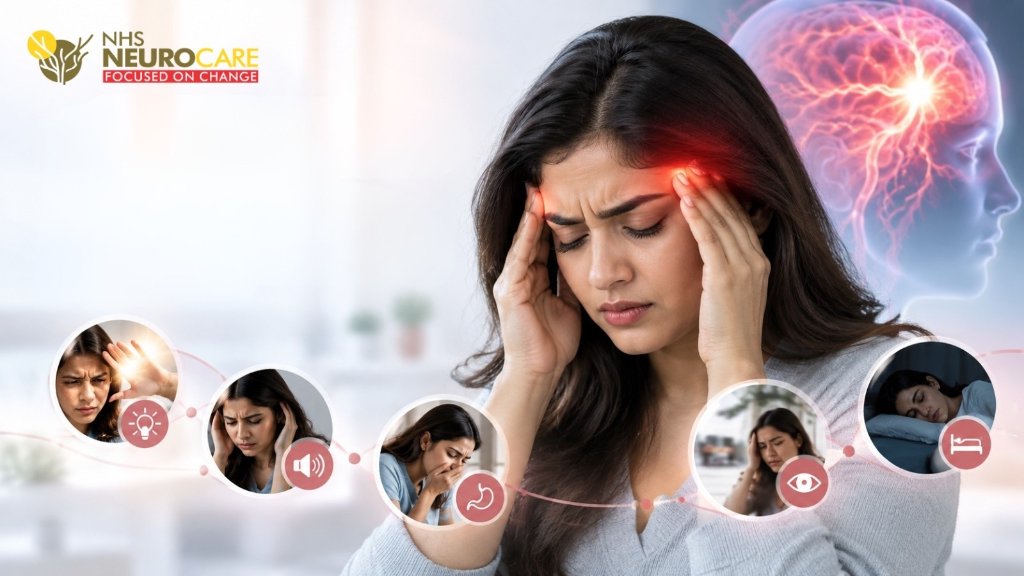
For some people, it begins with sensitivity to light or sound. For others, it brings throbbing head pain, nausea, visual disturbances or the need to stop everything and lie down in a dark room. Some patients experience migraine occasionally, while others find that repeated attacks begin controlling their work, travel, sleep and family time.
If migraine keeps returning, taking a painkiller every time may provide temporary relief—but it does not necessarily address the pattern behind repeated attacks.
At NHS Neurocare, a unit of NHS Hospital, Jalandhar, migraine patients receive specialist neurological evaluation and personalised treatment under the guidance of Dr Sandeep Goel, DM Neurology, Senior Neurologist and Founder, Director & Head of Neurology.
With 27+ years of specialised neurological experience and lakhs of patients treated, Dr Sandeep Goel has extensive clinical experience in managing headache and migraine disorders.
Migraine Treatment Shouldn’t Begin with Another Painkiller. It Should Begin with Understanding Your Migraine.
Is Your Headache Actually a Migraine?
Many people live with migraine for years while describing it simply as:
“My head hurts very badly.”
But migraine can involve much more than head pain.
A migraine attack may include:
- Throbbing or pulsating headache
- Pain on one side or both sides of the head
- Nausea
- Vomiting
- Sensitivity to light
- Sensitivity to sound
- Sensitivity to smells
- Blurred or disturbed vision
- Dizziness
- Difficulty concentrating
- Fatigue
- Visual or sensory symptoms before the headache in some patients
Not every patient experiences every symptom, and migraine can feel different from one person to another.
That is why diagnosis should be based on the complete pattern of symptoms, rather than the severity of pain alone.
What Does a Migraine Attack Feel Like?
Imagine having an important meeting, family function or journey planned—and suddenly you notice the familiar signs.
The head starts throbbing.
Normal light feels too bright.
Ordinary sounds become uncomfortable.
You feel nauseated.
You want to stop whatever you are doing and find somewhere quiet.
A few hours later the pain may settle, but there is another problem:
You don’t know when it will happen again.
For many patients, this unpredictability is one of the most difficult parts of living with migraine.
Effective migraine management therefore focuses not only on relieving an individual attack but also on understanding how frequently attacks occur, what may trigger them and how much they are affecting everyday life.
Why Does Migraine Keep Coming Back?
Migraine is a neurological disorder with a tendency to recur.
Different people may notice different triggers, and sometimes an attack occurs without an obvious trigger.
Commonly reported triggers or contributing factors may include:
Irregular Sleep
Sleeping too little, changing sleep schedules or sometimes sleeping significantly longer than usual can be associated with attacks in susceptible people.
Skipping Meals
Long gaps between meals may trigger migraine in some patients.
Stress
Periods of emotional or physical stress may influence migraine frequency.
Interestingly, some people experience migraine after a stressful period ends—sometimes called a “let-down” or weekend migraine pattern.
Dehydration
Inadequate fluid intake can contribute to headache in susceptible individuals.
Hormonal Changes
Some women notice migraine attacks around menstruation or other periods of hormonal change.
Bright Lights, Strong Smells or Loud Sounds
Sensory stimuli may trigger or worsen symptoms in certain patients.
Particular Foods or Drinks
Food-related triggers vary considerably between individuals. There is usually little value in unnecessarily restricting multiple foods unless a consistent relationship is identified.
Weather and Routine Changes
Some migraine patients report attacks associated with weather changes, travelling, disturbed sleep or major changes in routine.
The goal is not to fear every possible trigger.
The better approach is to identify your migraine pattern.
Migraine with Aura and Migraine without Aura
Not all migraines are the same.
Migraine Without Aura
This is a common form of migraine. Headache may be accompanied by nausea and sensitivity to light or sound without preceding neurological symptoms.
Migraine With Aura
Some people experience temporary neurological symptoms before or around the migraine attack.
These may include:
- Flashing lights
- Zigzag patterns
- Blind spots or altered vision
- Tingling or numbness
- Other temporary neurological symptoms
New or unusual neurological symptoms should not automatically be assumed to be migraine, particularly when the diagnosis has never previously been established.
A neurological assessment can help distinguish a typical migraine pattern from symptoms requiring further investigation.
How Often Are You Having Migraine?
This is one of the most important questions in migraine treatment.
Do you have:
1 migraine day a month?
4 migraine days a month?
10 headache days a month?
Headache on most days?
The answer can influence the management strategy.
A patient experiencing occasional attacks may require a different approach from someone whose migraine is repeatedly disrupting daily activities.
Therefore, during your consultation, don’t only tell your neurologist:
“I have migraine.”
Tell them:
“I have approximately ___ headache days every month.”
That information is extremely useful.
When Migraine Starts Taking Over Your Routine
Migraine severity should not be judged only by a pain score.
Ask yourself:
- Am I missing work because of migraine?
- Do I cancel social plans?
- Am I afraid to travel because an attack may start?
- Do I need to lie down during attacks?
- Am I frequently taking painkillers?
- Is migraine disturbing my sleep?
- Is my family routine affected?
- Do I plan my activities around my headaches?
If the answer to several of these questions is yes, migraine is having a meaningful impact on your quality of life.
That deserves proper assessment.
How Is Migraine Diagnosed?
Migraine diagnosis usually begins with a detailed clinical history.
There is no single blood test that confirms every case of migraine.
At NHS Neurocare, assessment may include discussion of:
• Your Headache Pattern
Where does the pain occur? How does it feel? How long does it last?
• Frequency
How many headache or migraine days do you experience every month?
• Associated Symptoms
Are there nausea, vomiting, light sensitivity, sound sensitivity, visual symptoms or dizziness?
• Possible Triggers
Is there a relationship with sleep, meals, stress, menstruation, travel or other factors?
• Medicines
Which medicines do you take during an attack, how frequently do you take them, and how well do they work?
• Family and Medical History
Relevant medical and family history may provide additional information.
• Neurological Examination
A clinical neurological examination can help determine whether additional investigation is necessary.
Does Migraine Require an MRI?
Not every migraine patient needs an MRI.
This is important because many patients arrive worried that repeated headaches automatically mean something abnormal should appear on a brain scan.
Migraine is primarily diagnosed through clinical assessment of the patient’s symptoms and headache pattern.
Brain imaging may be considered when the history, examination or particular warning signs make further investigation appropriate.
Therefore, the question is not:
“I have migraine—why hasn’t someone ordered an MRI?”
The better question is:
“Based on my symptoms and examination, do I need an MRI?”
At NHS Neurocare, advanced neurological imaging including MRI and CT is available when clinically indicated.
Can You Have Severe Migraine with a Normal MRI?
Yes.
A normal MRI does not mean that your migraine symptoms are not genuine.
Routine structural brain imaging can be normal in people who experience significant migraine attacks.
This is why migraine treatment should not stop simply because someone says:
“Your scan is normal.”
The next step is to understand the headache pattern and plan appropriate management.
How Is Migraine Treated?
There is no single migraine treatment that is right for everyone.
A personalised migraine management plan may consider two broad goals:
1. Managing the Migraine Attack
Treatment during an attack aims to reduce symptoms and help the patient return to normal activities.
The appropriate treatment depends on factors such as attack severity, associated symptoms, medical history and previous response to medication.
2. Preventing Future Migraine Attacks
When migraine attacks are frequent, disabling or difficult to manage, preventive treatment may be considered.
The objective is to reduce the:
of future migraine attacks.
The decision about preventive treatment should be individualised after clinical assessment.
Are You Taking Painkillers Too Often?
This deserves special attention.
A patient develops migraine.
They take a painkiller.
It works temporarily.
Another headache comes.
They take another tablet.
Eventually, medication may be used on many days every month.
In some patients, frequent use of acute headache medication can contribute to medication-overuse headache, making the headache cycle more difficult to control.
More painkillers do not always mean better migraine control.
If you are frequently reaching for headache medication, tell your neurologist exactly what you take and how often you take it.
Do not abruptly stop prescribed medicines without medical advice.
The Migraine Diary: A Simple Tool That Can Make a Big Difference
Before your migraine consultation, start recording your attacks.
A useful migraine diary can include:
Date
Time migraine started
How long it lasted
Pain severity
Possible trigger
Associated symptoms
Medicine taken
How quickly you improved
Menstrual cycle, where relevant
After several weeks, patterns may become clearer.
For example:
Migraine mostly after missed breakfast
Migraine around menstruation
Headache after disturbed sleep
Weekend headaches
Increasing number of painkiller days
These observations can make your consultation much more useful.
Lifestyle Matters—But Migraine Is Not “Just Lifestyle”
Patients are sometimes told:
“Drink more water.”
“Sleep properly.”
“Don’t take stress.”
These habits can certainly matter, but migraine is a neurological disorder and should not be dismissed as merely a lifestyle problem.
Helpful habits may include:
- Maintaining regular sleep
- Avoiding prolonged fasting or skipped meals
- Staying adequately hydrated
- Maintaining regular physical activity as appropriate
- Identifying personal triggers rather than avoiding everything
- Managing stress appropriately
- Limiting unnecessary frequent painkiller use
- Following prescribed treatment consistently
The aim is consistency, not an impossible “perfect lifestyle”.
Migraine in Women
Migraine can have an important relationship with hormonal changes.
Some women notice attacks:
- Before or during menstruation
- Around hormonal fluctuations
- During particular stages of reproductive life
If migraine follows a menstrual pattern, recording this in a migraine diary can help the neurologist understand the relationship.
Women who are pregnant, planning pregnancy or breastfeeding should discuss migraine medicines with their treating doctor rather than self-medicating.
Can Children and Young Adults Have Migraine?
Yes.
Migraine is not limited to middle-aged adults.
Children, teenagers and young adults can also experience migraine, although the symptoms and pattern may sometimes differ.
Repeated headache affecting school, studies, sports, sleep or daily activities should be appropriately evaluated rather than repeatedly attributed to screen time, stress or weakness without assessment.
When a “Migraine” May Need Urgent Attention
A person with an established migraine pattern often learns to recognise their usual attacks.
However, not every severe headache should automatically be labelled migraine.
Seek urgent medical attention for:
- A sudden, extremely severe headache
- A headache dramatically different from your usual migraine
- New weakness or numbness
- Difficulty speaking
- Loss of consciousness
- New confusion
- Seizure
- Severe headache following head injury
- Headache with high fever and neck stiffness
- New or persistent major visual disturbance
- Sudden neurological symptoms
If symptoms are new, severe or unusual, do not simply take your usual migraine medicine and wait.
Why Choose NHS Neurocare for Migraine Treatment in Jalandhar?
Migraine treatment becomes more effective when the focus moves from simply stopping pain to understanding the patient’s complete migraine pattern.
At NHS Neurocare, Jalandhar, patients have access to specialist neurological assessment supported by advanced diagnostic and neurological infrastructure.
The Neurology Department is led by:
Dr Sandeep Goel
DM Neurology | Senior Neurologist
Founder, Director & Head of Neurology
With 27+ years of specialised experience in neurological care, Dr Sandeep Goel has treated lakhs of patients with neurological conditions.
His areas of clinical expertise include:
- Headache & Migraine
- Stroke & Thrombolysis
- Epilepsy
- Parkinson’s & Movement Disorders
- Multiple Sclerosis
- Dementia & Memory Disorders
- Vertigo & Balance Disorders
- Interventional Neurology
For patients with recurring, complicated or difficult-to-control migraine, extensive neurological experience can be particularly valuable in recognising the headache pattern, deciding when investigations are necessary and developing an individualised treatment strategy.
Looking for a Migraine Specialist in Jalandhar?
If you are searching for a Migraine Specialist in Jalandhar, Headache Specialist in Jalandhar or Neurologist for Migraine in Jalandhar, NHS Neurocare provides specialist neurological consultation for patients experiencing recurrent migraine and other headache disorders.
You may particularly consider an appointment if:
Migraine keeps returning
Painkillers provide only temporary relief
Your attacks are becoming more frequent
Migraine is affecting work or family activities
Your headache pattern has changed
You experience aura or neurological symptoms
You are uncertain whether your headaches are actually migraine
Don’t Count Only Your Headaches. Count the Days Migraine Takes Away From You.
Frequently Asked Questions About Migraine
Is migraine just a severe headache?
No. Migraine is a neurological disorder that can include headache along with nausea, vomiting, light or sound sensitivity, visual disturbances and other symptoms.
Can migraine occur on only one side?
Yes. Migraine frequently causes one-sided pain, although some patients experience pain on both sides.
Can migraine happen without vomiting?
Yes. Not everyone with migraine experiences nausea or vomiting.
Why do I wake up with migraine?
Morning headaches can have several possible causes. Sleep pattern, migraine itself and other conditions may contribute. Frequent morning headaches should be assessed rather than assumed to have one cause.
Why do I get migraine on weekends?
Changes in sleep, meals, caffeine intake, routine or the transition after a stressful working week may contribute to weekend attacks in some patients.
Does migraine show on MRI?
Migraine is primarily a clinical diagnosis. Routine structural MRI may be normal in patients with migraine.
Can migraine be cured permanently?
Migraine is generally managed rather than promised a permanent cure. Appropriate treatment can help many patients reduce the frequency, severity and impact of attacks.
Can stress cause migraine?
Stress may trigger or worsen migraine in some individuals, but migraine should not simply be dismissed as a stress-related headache.
Can migraine become more frequent?
Yes. Headache patterns can change over time. Increasing frequency is an important reason to review treatment and medication use.
Which doctor should I consult for recurring migraine?
A neurologist with experience in headache disorders can evaluate recurring, severe, unusual or difficult-to-control migraine and determine an appropriate treatment strategy.
Who provides migraine treatment in Jalandhar at NHS Neurocare?
NHS Neurocare’s neurology services are led by Dr Sandeep Goel, DM Neurology, Senior Neurologist with 27+ years of specialised neurological experience and experience treating lakhs of neurological patients.
Take Control of Your Migraine Before It Controls Your Routine
Living with migraine should not mean constantly wondering:
“When will the next attack come?”
If headaches are becoming frequent, medicines provide only temporary relief, or migraine is affecting your work, sleep, travel and everyday activities, consider a specialist neurological assessment.
NHS Neurocare – Advanced Neurological Care
Dr Sandeep Goel – DM Neurology
27+ Years of Specialised Neurological Experience
Lakhs of Patients Treated
Special Expertise in Headache & Migraine
Neurology OPD available in Jalandhar & Kapurthala

Dr. Sandeep Goel
DM Neurology | Chief Neurologist & Founder Director (27+ Years Experience)
Leading neurologist and headache expert in Punjab with extensive experience treating acute and chronic migraine, vestibular migraine, cluster headaches, and medication-overuse headaches at NHS Neurocare, NHS Hospital, Jalandhar.
Ready for Effective, Personalised Migraine Relief?
Don’t let repeated migraine attacks dictate your work, travel, and family life. Book an in-depth clinical consultation with Dr. Sandeep Goel today.