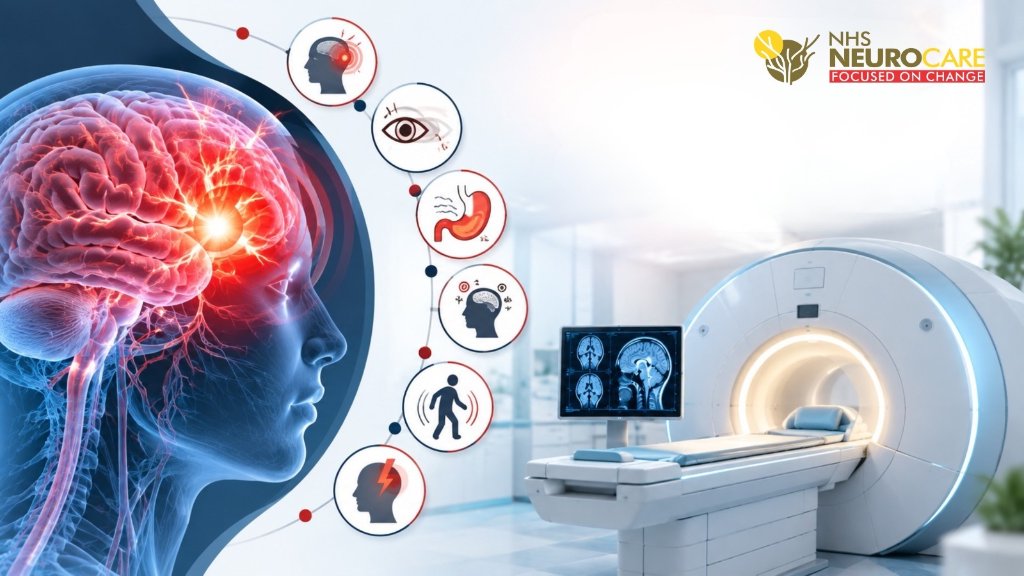
When Does a Headache Need an MRI?
Not Every Headache Needs a Brain Scan
Founder, Director & Head of Neurology •
NHS Neurocare, Jalandhar
A headache can be worrying, especially when it is severe, keeps returning or feels different from usual. Many patients immediately wonder:
“Do I need an MRI of the brain?”
The answer is: not always.
Most headaches are caused by primary headache disorders such as migraine or tension-type headache and may not require brain imaging. An MRI is usually considered when the headache pattern, neurological examination or associated symptoms suggest that further investigation is needed.
At NHS Neurocare, Jalandhar, patients with frequent, unusual or complex headaches are evaluated by the neurology team led by Dr Sandeep Goel, DM Neurology, Founder, Director & Head of Neurology, with 27+ years of specialised neurological experience and experience treating lakhs of patients.
The decision to advise an MRI should be based on the patient’s symptoms and clinical findings—not simply on the presence of a headache.
Why Is an MRI Done for Headache?
MRI stands for Magnetic Resonance Imaging.
It produces detailed images of the brain and surrounding structures and may help doctors evaluate whether there is an underlying structural cause for a headache.
However, an MRI is not a test for migraine itself.
Migraine is generally diagnosed from the patient’s history, headache pattern and neurological examination. Many patients with migraine have a normal MRI.
This is why the important question is not:
“I have a headache, so should I get an MRI?”
It is:
“Does my headache pattern suggest that brain imaging is necessary?”
When Might a Headache Need an MRI?
A neurologist may consider brain imaging when one or more warning signs are present.
1. A New or Unusual Headache Pattern
If you have experienced headaches for years but suddenly develop a headache that feels completely different in intensity, location or character, further evaluation may be needed.
A significant change in a previously stable headache pattern should not automatically be assumed to be another migraine attack.
2. Headache with Weakness or Numbness
A headache accompanied by sudden weakness, numbness or heaviness in the face, arm or leg needs urgent neurological evaluation.
Especially concerning symptoms include:
- Weakness on one side of the body
- Facial drooping
- Numbness on one side
- Difficulty walking
- Loss of balance
These symptoms may indicate a neurological emergency and should not wait for a routine outpatient MRI appointment.
3. Headache with Speech Difficulty
A headache associated with:
- Slurred speech
- Difficulty finding words
- Difficulty understanding speech
- Sudden inability to speak properly
requires prompt medical attention.
The priority is immediate clinical assessment. Imaging may then be performed depending on the suspected cause.
4. A Sudden, Extremely Severe Headache
A headache that starts suddenly and becomes very severe within seconds or minutes requires urgent evaluation.
Patients may describe it as:
“The worst headache of my life.”
A sudden severe headache should not be treated as an ordinary migraine without medical assessment.
Depending on the situation, urgent brain imaging may be necessary.
5. Headache with Seizure
A new seizure occurring with a headache requires neurological evaluation.
Further investigation, including brain imaging, may be advised based on the clinical picture.
6. Headache with Loss of Consciousness or Confusion
A headache associated with:
- Fainting
- Loss of consciousness
- New confusion
- Altered behaviour
- Severe drowsiness
should be assessed urgently.
These are not symptoms to simply observe at home.
7. Headache After a Head Injury
Headaches can occur after a head injury, but certain symptoms require urgent attention.
Seek medical care if headache after injury is accompanied by:
- Repeated vomiting
- Increasing drowsiness
- Confusion
- Weakness
- Seizure
- Worsening pain
- Loss of consciousness
In an acute head injury, the doctor may decide that CT scan rather than MRI is the more appropriate first investigation, depending on the clinical situation.
8. Headache with Fever and Neck Stiffness
A severe headache with fever and marked neck stiffness can indicate an infection or another serious condition requiring urgent evaluation.
In such situations, imaging may form part of the investigation, but the patient needs immediate medical assessment rather than waiting for a routine scan.
9. Headache with New Visual Symptoms
Migraine can cause visual aura in some people.
However, sudden or unusual visual symptoms—especially if they have never happened before—should be assessed properly.
Examples include:
- Sudden loss of vision
- Persistent double vision
- Major change in vision
- Visual symptoms with weakness or speech difficulty
Whether imaging is required depends on the overall neurological assessment.
10. Headache That Is Progressively Getting Worse
A headache that gradually becomes:
deserves medical evaluation.
This is especially important if the pattern is different from your usual headache or is accompanied by neurological symptoms.
11. A New Headache in an Older Adult
A completely new headache beginning later in life may require more careful evaluation than a stable headache pattern that has been present for many years.
The need for imaging depends on the patient’s age, medical history, examination and associated symptoms.
12. Headache in a Patient with Certain Medical Conditions
A doctor may have a lower threshold for considering imaging in patients with particular medical histories.
Examples may include patients with:
- Certain cancers
- Significant immune suppression
- Serious systemic illness
- Recent neurological problems
The decision is individual and should be made after clinical assessment.
Does Migraine Usually Need an MRI?
No.
A typical migraine pattern with a normal neurological examination often does not automatically require MRI.
Migraine may present with:
- One-sided or two-sided headache
- Throbbing pain
- Nausea
- Vomiting
- Light sensitivity
- Sound sensitivity
- Visual aura in some patients
These symptoms can be very severe even when the MRI is completely normal.
Severity alone does not determine the need for imaging.
A very painful migraine does not automatically mean there is a structural brain problem.
Can You Have Severe Headaches with a Normal MRI?
Yes.
This is very important for patients to understand.
Some people have:
- Severe migraine
- Frequent headaches
- Chronic migraine
- Tension-type headache
- Other primary headache disorders
while their MRI remains normal.
A normal MRI does not mean:
“There is nothing wrong.”
It means that no relevant structural abnormality was identified on that scan.
The next step is to understand what type of headache disorder is causing the symptoms and how it should be treated.
Headache Every Day but MRI Is Normal – What Should You Do?
If your MRI is normal but headaches continue, do not simply keep repeating scans.
Instead, a neurologist may review:
- Number of headache days per month
- Type of pain
- Location
- Duration
- Nausea or vomiting
- Light and sound sensitivity
- Visual symptoms
- Sleep pattern
- Triggers
- Medication use
- Previous treatment response
This can help determine whether the patient has migraine, tension-type headache, medication-overuse headache or another headache disorder.
A normal MRI does not replace a proper headache diagnosis.
MRI or CT Scan for Headache – Which One Is Better?
This depends on the clinical situation.
MRI
MRI provides detailed imaging of the brain and is often useful when a neurologist needs to investigate certain non-emergency neurological causes of headache.
CT Scan
CT may be preferred in some emergency situations because it is quick and can be especially useful in acute settings such as:
- Head injury
- Suspected bleeding
- Sudden neurological emergency
The decision between MRI and CT should be made by the treating doctor, based on the symptoms and urgency.
Should You Get an MRI Just for Reassurance?
It is understandable to want reassurance when headaches are recurring.
But unnecessary imaging is not always the best approach.
A more useful first step is:
This avoids both extremes:
Ignoring warning signs
and
Scanning every headache unnecessarily
What Happens During a Headache Consultation?
Before deciding whether imaging is necessary, your neurologist will usually ask detailed questions.
These may include:
• When did the headaches begin?
• Was the onset sudden or gradual?
• How often do they occur?
Once a month? Several days per week? Every day?
• Where is the pain?
One side? Both sides? Behind the eye? Back of the head?
• What does it feel like?
Throbbing? Tightening? Pressure? Stabbing?
• How long does it last?
Minutes, hours or days?
• Are there associated symptoms?
Nausea, vomiting, dizziness, visual changes, numbness or speech difficulty?
• Has the pattern changed?
A changing pattern may be more important than the pain intensity alone.
• How much medication are you taking?
Frequent use of headache medicines can itself contribute to recurrent headaches in some patients.
Keep a Headache Diary Before Your Appointment
If your headaches are frequent, a simple diary can help.
Record:
- Date
- Time of onset
- Duration
- Severity
- Location
- Associated symptoms
- Possible trigger
- Medicine taken
- Response to medicine
At the end of the month, note:
Total Headache Days: ___
This information can help your neurologist decide whether imaging is necessary and what type of headache you may be experiencing.
When Should You Go to Emergency Instead of Booking an MRI?
Do not wait for a routine MRI appointment if headache is accompanied by:
- Sudden weakness or numbness
- Difficulty speaking
- Loss of consciousness
- Seizure
- Severe confusion
- Sudden vision loss
- A sudden extremely severe headache
- Significant head injury
- Severe headache with fever and neck stiffness
These symptoms require urgent medical assessment.
NHS Neurocare/NHS Hospital provides 24/7 neurological and emergency support for time-sensitive neurological conditions.
Why Choose NHS Neurocare for Headache Evaluation?
At NHS Neurocare, Jalandhar, patients with migraine, frequent headaches and unusual headache patterns receive specialist neurological evaluation supported by advanced diagnostic facilities.
The neurology service is led by:
Dr Sandeep Goel
DM Neurology | Senior Neurologist
Founder, Director & Head of Neurology
With 27+ years of specialised neurological experience and lakhs of patients treated, Dr Sandeep Goel has extensive experience in neurological conditions including:
- Headache & Migraine
- Stroke
- Epilepsy
- Parkinson’s Disease
- Dementia
- Multiple Sclerosis
- Vertigo & Balance Disorders
- Interventional Neurology
The aim is not to order a scan simply because a patient has a headache.
The aim is to identify who needs imaging, who does not, and what the headache pattern actually means.
Frequently Asked Questions
Does every headache need an MRI?
No. Many headaches, including typical migraine and tension-type headache, may not require brain imaging.
When should a headache be investigated with MRI?
MRI may be considered when there is a new or changing headache pattern, neurological symptoms, progressive worsening or other concerning clinical findings.
Does migraine show on MRI?
Migraine is usually diagnosed clinically. A patient with migraine may have a normal structural MRI.
Can I have daily headaches with a normal MRI?
Yes. Primary headache disorders can cause frequent headaches even when brain imaging is normal.
Is MRI better than CT for headache?
Neither test is “better” in every situation. MRI and CT have different roles, and the appropriate investigation depends on the symptoms and urgency.
Should I get an MRI if my headache is very severe?
Severity alone does not automatically mean an MRI is required. A sudden severe headache, however, needs urgent medical assessment.
Do headaches with weakness need an MRI?
Headache with sudden weakness, numbness or speech difficulty is a neurological emergency and should be evaluated immediately. Imaging is usually determined urgently by the medical team.
Is MRI needed for chronic migraine?
Not necessarily. If the pattern is typical and neurological examination is normal, routine repeat imaging may not be required.
Why does my head hurt if my MRI is normal?
Primary headache disorders such as migraine can cause significant pain without showing a structural abnormality on MRI.
Who should decide whether I need an MRI?
A doctor—preferably a neurologist for persistent or complex headaches—should decide based on your history, examination and warning signs.
Worried About Your Headache? Start with the Right Evaluation
A headache does not automatically mean you need an MRI.
But a headache with warning signs, a changing pattern or neurological symptoms should not be ignored.
At NHS Neurocare, specialist evaluation helps answer the question that matters most:
“Does this headache need imaging—and if not, what is actually causing it?”
Dr Sandeep Goel – DM Neurology
27+ Years of Specialised Neurological Experience
Lakhs of Patients Treated
Headache & Migraine Expertise
NHS Neurocare – A Unit of NHS Hospital, Jalandhar

Dr. Sandeep Goel
DM Neurology | Chief Neurologist & Founder Director (27+ Years Experience)
Leading expert in headache evaluation, migraine management, tension-type headaches, and neuro-imaging interpretation at NHS Neurocare, NHS Hospital, Jalandhar.
Worried About Your Headache or Need a Brain Scan Review?
Get a specialist neurological assessment from Dr. Sandeep Goel to determine whether imaging is truly needed and to identify the root cause of your pain.