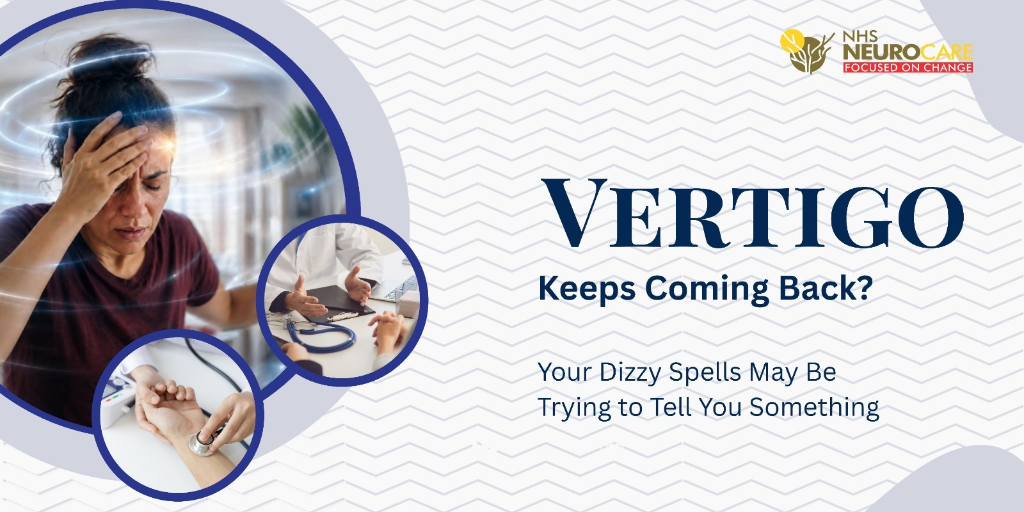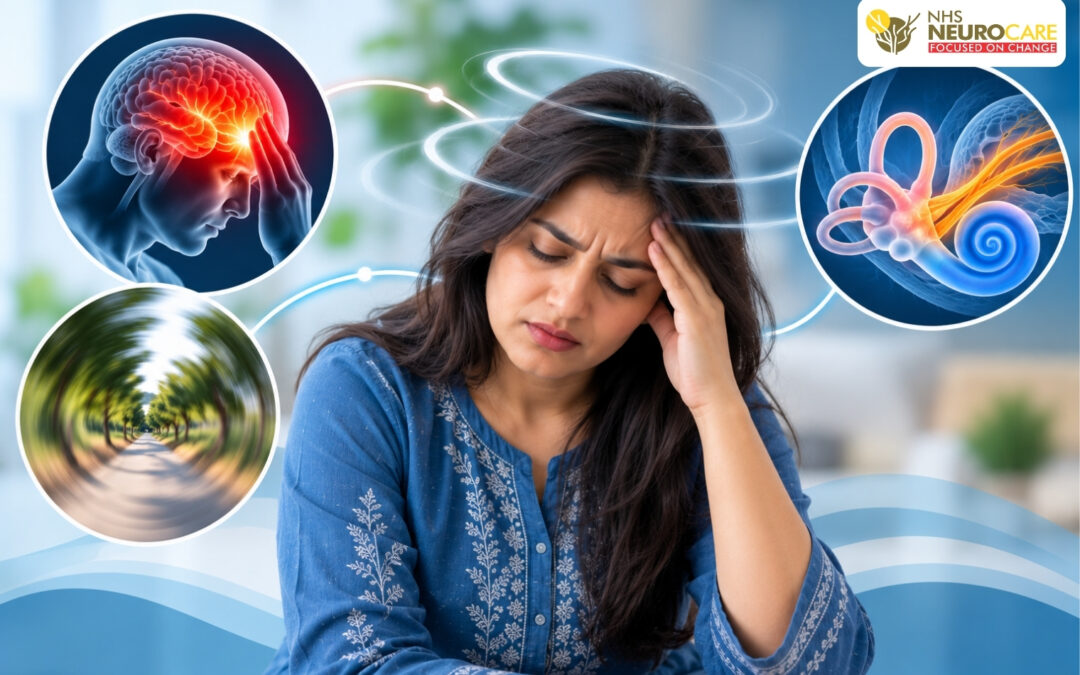
You feel as though the room is moving, but you are standing still.
Busy places make you uncomfortable. Bright lights seem unbearable. Travelling in a car makes the dizziness worse. You may feel unsteady while walking, and sometimes even simple head movements trigger an unpleasant sensation of motion.
But there is one confusing part:
You may not always have a headache.
For some people experiencing repeated episodes of vertigo or dizziness, the underlying problem may be vestibular migraine.
Vestibular migraine is a neurological condition in which migraine is associated with recurrent episodes of vertigo, dizziness, imbalance or sensitivity to movement. Headache can occur, but it does not have to accompany every episode.
At NHS Neurocare, NHS Hospital, Jalandhar, patients with recurrent vertigo, dizziness, migraine and balance problems can undergo neurological evaluation supported by specialised vertigo and balance assessment.
If dizziness keeps returning and no clear explanation has been found, it may be time to look beyond “weakness”, “gas”, “cervical” or a simple ear problem.
What Is Vestibular Migraine?
Vestibular migraine is a condition associated with both the migraine system and the brain’s balance system.
The vestibular system helps the brain understand where the body and head are positioned in space and allows us to maintain balance.
In vestibular migraine, people may experience episodes of:
- Vertigo
- Dizziness
- Unsteadiness
- Sensitivity to movement
- Motion sickness
- Head-motion-induced dizziness
- Visual sensitivity
- Migraine symptoms
Importantly, a severe headache does not have to occur during every vestibular migraine attack.
This is one reason why vestibular migraine can remain undiagnosed for a long time.
Can You Have a Vestibular Migraine Without a Headache?
Yes.
This is one of the most important facts about vestibular migraine.
Many people associate migraine only with severe headache. However, migraine is a neurological disorder that can produce a range of symptoms.
With vestibular migraine, vertigo or dizziness may be the dominant symptom.
Some people have a history of typical migraine headaches but later begin experiencing more dizziness than pain.
Others may experience:
- Vertigo without headache
- Dizziness followed by headache
- Headache followed by dizziness
- Light or sound sensitivity during vertigo
- Visual disturbances
- Nausea
- Motion sensitivity
Therefore, the absence of headache during an episode does not automatically rule out vestibular migraine.
What Does Vestibular Migraine Feel Like?
Vestibular migraine does not feel exactly the same for everyone.
Patients may describe:
“I feel like the room is spinning.”
“I feel as if I am moving even when I am sitting still.”
“My head feels heavy and I cannot focus.”
“I feel unsteady when I walk.”
“Crowded places and bright lights make me dizzy.”
“Travelling makes me nauseous and dizzy.”
“My tests are normal, but the dizziness keeps coming back.”
These descriptions can all represent different experiences of vestibular symptoms.
Common Symptoms of Vestibular Migraine
Symptoms may include:
- Recurrent vertigo
- Spinning sensation
- Dizziness
- Loss of balance
- Unsteadiness while walking
- Motion sensitivity
- Nausea
- Vomiting
- Sensitivity to light
- Sensitivity to sound
- Headache
- Visual disturbances
- Difficulty concentrating
- Head pressure
- Sensitivity to busy visual environments
- Dizziness triggered by head movement
Symptoms can vary between attacks.
One episode may involve headache and vertigo, while another may mainly cause imbalance or visual sensitivity.
How Long Does Vestibular Migraine Last?
Vestibular migraine episodes can vary considerably in duration.
For some people, symptoms may last only minutes. For others, episodes can continue for several hours or even longer.
This variability can make vestibular migraine difficult for patients to recognise.
The important pattern is often recurrent episodes of vestibular symptoms in someone with current or previous migraine features.
A neurologist evaluates the complete symptom pattern rather than relying on a single attack.
What Can Trigger Vestibular Migraine?
Triggers vary from person to person.
Possible migraine triggers may include:
- Lack of sleep
- Irregular sleep
- Stress
- Dehydration
- Skipping meals
- Bright or flashing lights
- Excessive screen exposure
- Loud environments
- Strong smells
- Hormonal changes
- Certain foods in susceptible individuals
- Alcohol
- Excessive caffeine or caffeine withdrawal
- Travel
- Busy visual environments
Not everyone has the same triggers.
Keeping a migraine and dizziness diary can help identify patterns between lifestyle factors and symptoms.
Why Do Supermarkets, Malls or Crowded Places Make Me Dizzy?
This is an interesting complaint reported by some patients with vestibular disorders.
Large supermarkets, malls, traffic, scrolling screens and crowded environments create significant visual movement.
For someone with heightened visual-motion sensitivity, processing all this movement can provoke:
- Dizziness
- Imbalance
- Nausea
- Disorientation
- Head discomfort
Patients sometimes describe feeling perfectly comfortable at home but unusually dizzy in visually busy environments.
This information can be useful during a specialist assessment.
Vestibular Migraine vs BPPV: What Is the Difference?
Both conditions can cause vertigo, but they are different disorders.
BPPV
Benign Paroxysmal Positional Vertigo commonly causes short episodes of spinning triggered by specific changes in head position, such as:
- Rolling over in bed
- Looking upwards
- Lying down
- Getting up
It is related to displaced crystals within the inner-ear balance system.
Vestibular Migraine
Vestibular migraine is a neurological migraine disorder.
Episodes may involve:
- Vertigo
- Motion sensitivity
- Light or sound sensitivity
- Headache
- Visual sensitivity
- Nausea
- Imbalance
Symptoms may last longer than typical BPPV episodes and are not always linked to one specific head position.
However, symptoms can overlap.
Correct diagnosis matters because the treatment approaches are different.
Vestibular Migraine vs Ménière’s Disease
Ménière’s disease and vestibular migraine can sometimes produce overlapping symptoms such as vertigo and nausea.
However, Ménière’s disease commonly involves auditory symptoms, which may include:
- Fluctuating hearing loss
- Ringing in the ear
- A feeling of pressure or fullness in the ear
Vestibular migraine more commonly involves migraine-related features such as:
- Light sensitivity
- Sound sensitivity
- Migraine headache
- Visual aura
- Motion sensitivity
Some patients can have complex or overlapping symptoms, making specialist assessment important.
Is Vestibular Migraine Dangerous?
Vestibular migraine itself is generally not considered a life-threatening condition.
However, new or sudden severe dizziness should never automatically be labelled as migraine, particularly if neurological warning signs are present.
Vertigo can occasionally occur with serious neurological conditions, including stroke.
When Is Dizziness an Emergency?
Seek immediate emergency medical attention if sudden dizziness or vertigo occurs with:
- Facial drooping
- Weakness or numbness on one side
- Difficulty speaking
- Sudden confusion
- Double vision
- Sudden loss of vision
- Severe difficulty walking
- Loss of coordination
- Sudden severe headache
- Reduced consciousness
- New neurological symptoms
When these symptoms appear suddenly, do not wait for the dizziness to settle.
Emergency neurological assessment is essential.
How Is Vestibular Migraine Diagnosed?
There is no single blood test or scan that independently confirms every case of vestibular migraine.
Diagnosis relies heavily on the patient’s clinical history, pattern of attacks and neurological assessment.
Your neurologist may ask:
- What exactly does the dizziness feel like?
- How long does each episode last?
- How frequently does it happen?
- Do you experience headache?
- Do you have a previous history of migraine?
- Are you sensitive to light or sound?
- Do you experience visual aura?
- Does travelling trigger symptoms?
- Are you sensitive to head movement?
- Do busy visual environments make you dizzy?
- Do you experience hearing changes?
- What triggers the attacks?
- Are there any neurological symptoms?
The answers help the doctor distinguish vestibular migraine from other causes of recurrent dizziness.
Do I Need an MRI for Vestibular Migraine?
Not every patient with vestibular migraine requires brain imaging.
However, CT, MRI or other investigations may be recommended when clinically appropriate, particularly if:
- Symptoms are new or unusual
- Neurological signs are present
- The pattern has changed
- The diagnosis is uncertain
- Another neurological condition needs to be excluded
At NHS Neurocare, access to advanced neurological imaging allows investigations to be planned when clinically indicated.
Specialised Vertigo Assessment at NHS Neurocare
Dizziness can arise from multiple systems.
This means the correct question is not simply:
“Do you have vertigo?”
It is:
“Why are you having vertigo?”
NHS Neurocare has access to a dedicated Vertigo Lab for specialised evaluation of patients experiencing dizziness, vertigo and balance disorders.
Depending on the clinical situation, assessment may help evaluate:
- Balance function
- Eye movements
- Vestibular responses
- Positional dizziness
- Patterns of nystagmus
- Possible peripheral vestibular involvement
- Possible neurological causes
This can be particularly valuable when dizziness keeps returning despite previous treatment.
How Is Vestibular Migraine Treated?
Treatment is individualised according to:
- Frequency of attacks
- Severity of symptoms
- Presence of headache
- Associated migraine symptoms
- Identified triggers
- Other health conditions
- Impact on everyday life
A treatment plan may combine acute symptom management, preventive treatment, lifestyle modification and vestibular rehabilitation, depending on individual requirements.
1. Managing an Acute Attack
During an acute episode, treatment may be prescribed to help control symptoms such as:
- Migraine headache
- Nausea
- Vomiting
- Severe dizziness
The appropriate medicine depends on the individual patient’s clinical condition and should be advised by a healthcare professional.
2. Preventive Migraine Treatment
When vestibular migraine attacks are frequent or significantly affect daily life, a neurologist may consider preventive migraine treatment.
The objective is to reduce:
- Frequency of episodes
- Severity
- Duration
- Migraine-associated symptoms
- Impact on everyday functioning
Treatment should be individualised rather than copied from another person’s migraine prescription.
3. Lifestyle and Trigger Management
Migraine management often involves creating consistency in everyday routines.
Helpful measures may include:
- Maintaining regular sleep
- Avoiding repeated sleep deprivation
- Eating meals regularly
- Staying adequately hydrated
- Managing excessive caffeine
- Exercising appropriately
- Managing stress
- Identifying personal triggers
- Taking regular screen breaks
These measures do not replace medical treatment where required, but they can form an important part of long-term migraine management.
Vestibular Rehabilitation
Some patients with ongoing imbalance or motion sensitivity may benefit from vestibular rehabilitation.
This is a specialised form of rehabilitation designed to help the brain adapt to abnormal or challenging balance signals.
Depending on individual requirements, exercises may focus on:
- Balance
- Eye-head coordination
- Walking stability
- Motion tolerance
- Visual-motion sensitivity
- Confidence with movement
Vestibular rehabilitation should be tailored to the patient’s condition.
Keep a Vestibular Migraine Diary
One of the simplest tools for patients experiencing recurrent symptoms is a diary.
Record:
- Date of the attack
- Time it started
- How long it lasted
- Whether you had headache
- Type of dizziness
- Sleep the previous night
- Meals
- Hydration
- Menstrual cycle where relevant
- Stress
- Screen exposure
- Travel
- Possible food triggers
- Medicines taken
Over several weeks, patterns may become clearer.
This information can also help your neurologist understand your condition.
Can Vestibular Migraine Be Cured?
Vestibular migraine can often be managed effectively, although the course varies from person to person.
The objective of treatment is to:
- Reduce attacks
- Reduce severity
- Control associated migraine symptoms
- Improve balance
- Identify and manage triggers
- Improve quality of life
Some patients experience long periods with few symptoms, while others require ongoing preventive management.
The most important step is establishing the correct diagnosis.
Why Does Vestibular Migraine Often Go Undiagnosed?
There are several reasons.
Patients may visit different doctors because the symptoms seem unrelated.
One day there is:
Headache.
Another day:
Dizziness.
Another:
Nausea.
Another:
Sensitivity to light.
And sometimes:
No headache at all.
Because vertigo is often associated primarily with the ear and migraine primarily with headache, the neurological connection can sometimes be overlooked.
This is why a detailed history is so important.
When Should You See a Neurologist?
Consider neurological assessment if:
- Vertigo keeps returning
- Dizziness remains unexplained
- You have a history of migraine
- Light or sound triggers symptoms
- You experience headache with dizziness
- Motion makes you unusually dizzy
- Busy places trigger imbalance
- Previous vertigo treatments have not worked
- Symptoms are affecting work or daily activities
- The pattern of your dizziness has changed
Recurring symptoms should not simply become your “new normal”.
Vestibular Migraine Treatment at NHS Neurocare, Jalandhar
At NHS Neurocare, NHS Hospital, Jalandhar, patients experiencing recurrent dizziness, vertigo, headaches, migraine and balance disorders can receive specialised neurological assessment.
The neurological care ecosystem includes access to:
- Experienced neurologists
- Dedicated Vertigo Lab
- Headache and migraine assessment
- Balance and vestibular evaluation
- Advanced MRI and CT imaging when required
- Physiotherapy and rehabilitation support
- Emergency neurological services
- Stroke-ready care
The aim is not merely to control the dizziness temporarily.
The aim is to understand why it keeps happening.
Experienced Neurology Care – Dr Sandeep Goel
NHS Neurocare is led by Dr Sandeep Goel, DM Neurology, Chief Neurologist and Founder Director, with more than 27 years of experience in Neurology.
His extensive clinical experience includes the assessment and management of migraine, headache, stroke, vertigo and a broad spectrum of neurological disorders.
For patients experiencing recurrent or unexplained vertigo, an experienced neurological evaluation can help determine whether symptoms are associated with vestibular migraine or whether another cause needs to be investigated.
Frequently Asked Questions About Vestibular Migraine
Can vestibular migraine occur without headache?
Yes. Some people experience vertigo, dizziness or imbalance without headache during individual attacks. A history of migraine or other migraine features may help establish the diagnosis.
Can vestibular migraine cause constant dizziness?
Some patients experience lingering imbalance or sensitivity between more distinct attacks. Persistent dizziness, however, should be assessed because other conditions can produce similar symptoms.
Does vestibular migraine cause room-spinning vertigo?
It can. Patients may experience spinning vertigo, non-spinning dizziness, rocking sensations, imbalance or motion sensitivity.
Can screens trigger vestibular migraine?
Bright screens, visual movement and prolonged screen exposure can trigger or worsen symptoms in some migraine-sensitive individuals.
Can lack of sleep trigger vestibular migraine?
Irregular or inadequate sleep is a recognised migraine trigger for many people.
Is vestibular migraine related to the ear or brain?
Vestibular migraine is considered a neurological migraine disorder, although its symptoms involve the vestibular system responsible for balance and spatial orientation.
How is vestibular migraine different from BPPV?
BPPV typically causes brief positional vertigo due to displaced inner-ear crystals. Vestibular migraine is associated with migraine mechanisms and may include vertigo, motion sensitivity, light sensitivity, headache and other migraine features.
Can stress make vestibular migraine worse?
Stress can be a migraine trigger for some people and may contribute to attacks or symptom severity.
Which doctor treats vestibular migraine?
Because vestibular migraine is a neurological migraine disorder, a neurologist can play an important role in diagnosis and management. Depending on symptoms, multidisciplinary vestibular assessment may also be useful.
Dizziness Keeps Returning? Don’t Keep Guessing the Cause.
Perhaps you have been told:
“It’s weakness.”
“It’s your ears.”
“It’s cervical.”
“It’s because you’re stressed.”
But your dizziness keeps coming back.
Recurring vertigo deserves a diagnosis, not repeated guesswork.
And remember:
Migraine doesn’t always mean headache.
Sometimes the symptom that brings a person to a neurologist is dizziness.
Book a Vestibular Migraine & Vertigo Assessment
If you are experiencing:
Recurring dizzinessVertigo with or without headacheMotion sensitivityBalance problemsLight or sound sensitivityUnexplained recurrent spinning sensations
consider a specialised neurological assessment at NHS Neurocare, NHS Hospital, Jalandhar.
NHS NeurocareAdvanced Neurology | Headache, Migraine & Vertigo Care | Jalandhar
Because Every Second Shapes Recovery.