Emergency Stroke Care
Immediate Stroke Emergency Care When Every Second Counts at NHS Neurocare (a unit of NHS Hospital)
Immediate Stroke Care When Every Second Counts
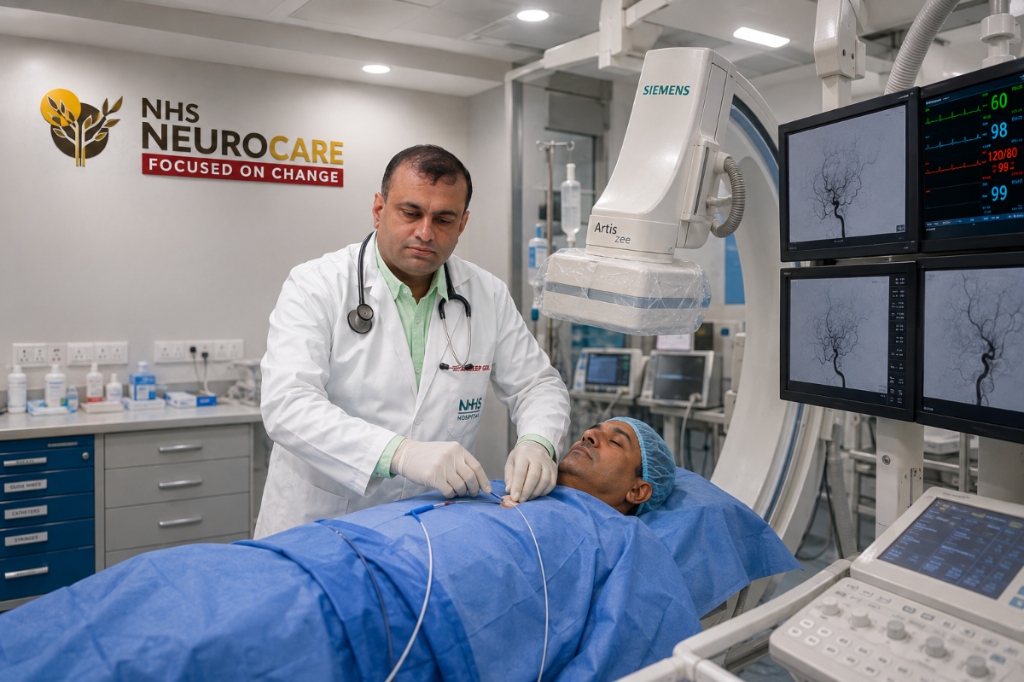
A stroke is a medical emergency where every second can make a difference. Delayed treatment may result in permanent brain damage, long-term disability, or loss of life. At NHS Neurocare (a unit of NHS Hospital), our Stroke Ready Centre is designed to deliver rapid, coordinated, and evidence-based emergency stroke care from the moment a patient arrives.
Our dedicated emergency team led by Dr Sandeep Goel (DM Neurology) has more than 20 years of experience in stroke management, ensuring that every patient receives immediate assessment, advanced diagnostics, timely intervention, and continuous monitoring.
With 24×7 CT & Latest 1.5 Tesla Silent MRI located inside the Emergency Department, a fully equipped Emergency Operation Theatre, and OT-grade lights over every emergency bed, we are prepared to respond without delay when every minute matters.
A Stroke Emergency Demands Immediate Action
A stroke occurs when the blood supply to part of the brain is interrupted or when bleeding occurs within the brain. Brain cells begin to die within minutes, making immediate medical attention critical.
At NHS Neurocare (a unit of NHS Hospital), our Stroke Ready Centre follows a streamlined emergency stroke protocol that focuses on rapid diagnosis, prompt treatment, and better patient outcomes.
Why Choose Our Emergency Stroke Services?

Dedicated Stroke Emergency Team with 20+ Years Experience
24×7 CT & Silent MRI Located Inside Emergency
Fully Equipped Emergency Operation Theatre
OT-Grade Lighting over Every Emergency Bed
Rapid Door-to-Needle Stroke Assessment
Multidisciplinary Neurologists & Surgeons
Zero Patient Transfer Delay
Seamless ICU & Cath Lab Transition
What Happens When a Stroke Patient Arrives?
Immediate Triage
Prioritised emergency code stroke evaluation
Brain Imaging
Instant CT / Silent MRI scan inside Emergency
Neuro Evaluation
Immediate review by senior neurologists
Emergency Treatment
Thrombolysis, Thrombectomy, or Surgery
Stroke ICU Care
24x7 critical monitoring & early rehab
Advanced Emergency Infrastructure
Dedicated Stroke Emergency Team 20+ Years Stroke Critical Expertise 24×7 Emergency Department Services CT Scanner Inside Emergency Department 1.5T Silent MRI Inside Emergency Department Emergency Operation Theatre OT-Grade Lights on Every Emergency Bed 3D Flat Panel Neuro Cath Lab Mechanical Thrombectomy Suite Dedicated Stroke ICUConditions Managed in Our Stroke Emergency
Recognise Stroke Early – Remember BE FAST
Immediate treatment can save brain function and improve recovery:
Balance
Sudden loss of balance or coordination
Eyes
Sudden blurred or loss of vision
Face
One side of the face droops
Arm
Weakness or numbness in one arm
Speech
Difficulty speaking or understanding
Time
Reach a Stroke Ready Centre immediately!
Frequently Asked Questions
Ready Every Second. Committed Every Day.
At NHS Neurocare (a unit of NHS Hospital), our Emergency Stroke Services are built around one goal—to deliver the right care at the right time. With an experienced stroke-focused emergency team, advanced imaging within the Emergency Department, an Emergency Operation Theatre, and comprehensive stroke infrastructure, our Stroke Ready Centre is equipped to respond rapidly and effectively when every second matters.