Vertigo & Balance Disorders Treatment
One of the Region’s First Dedicated Vertigo Labs for Accurate Diagnosis and Advanced Treatment in Jalandhar
Vertigo & Balance Disorders Treatment in Jalandhar
Sensation that the room is spinning, difficulty keeping your balance, or suffering from regular bouts of dizziness can be distressing and highly disruptive. Although these symptoms are frequently referred to simply as “vertigo”, they can stem from a range of conditions affecting the inner ear, brain, or wider nervous system.
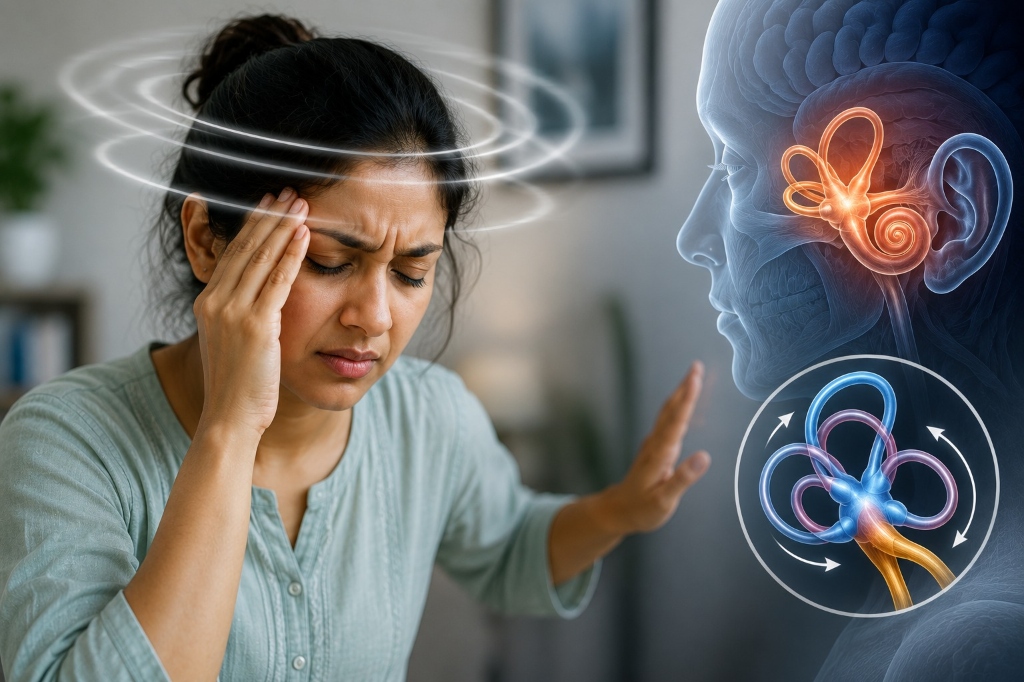
At NHS Neurocare (A Unit of NHS Hospital), we are proud to offer one of the region’s first dedicated Vertigo Labs, providing specialised evaluation and evidence-based treatment for patients with vertigo, dizziness and balance disorders. Led by Dr Sandeep Goel, Director & Senior Neurologist (DM Neurology) with over 27 years of specialised neurological experience, our team combines advanced diagnostic technology with personalised care to identify the exact cause of your symptoms and provide targeted treatment.
If you are looking for the best vertigo specialist in Jalandhar, vertigo treatment in Punjab or an experienced neurologist for dizziness and balance disorders, NHS Neurocare offers comprehensive care under one roof.
What is Vertigo?
Vertigo is not a disease itself—it is a symptom that creates the sensation that you or your surroundings are spinning or moving, even when you are completely still.
Unlike ordinary dizziness, vertigo often results from disorders affecting the inner ear (vestibular system) or the brain, making accurate diagnosis essential. Because several neurological conditions can present with vertigo, specialist assessment by a neurologist is often required.
At NHS Neurocare, we focus on identifying the underlying cause rather than simply treating the symptom.
Conditions We Diagnose and Treat
Our specialists manage a wide range of vestibular and neurological disorders, including:
- Benign Paroxysmal Positional Vertigo (BPPV)
- Vestibular Neuritis
- Labyrinthitis
- Ménière’s Disease
- Vestibular Migraine
- Cervicogenic Dizziness
- Persistent Postural-Perceptual Dizziness (PPPD)
- Balance Disorders
- Recurrent Dizziness
- Motion Sensitivity
- Central Vertigo
- Stroke-Related Vertigo
- Cerebellar Disorders
- Neurological Causes of Dizziness
Every patient undergoes a thorough assessment to determine the precise cause of symptoms before treatment begins.
Symptoms That Should Never Be Ignored
Seek specialist evaluation if you experience:
- A spinning sensation
- Recurrent dizziness
- Loss of balance
- Difficulty walking steadily
- Feeling as though you may fall
- Nausea or vomiting associated with dizziness
- Symptoms triggered by changing head position
- Ringing in the ears (tinnitus)
- Hearing changes
- Double vision
- Slurred speech
- Weakness or numbness accompanying dizziness
WARNING: Sudden vertigo associated with weakness, facial drooping or difficulty speaking may indicate a stroke and requires immediate emergency medical attention.
One of the Region’s First Dedicated Vertigo Labs
NHS Neurocare has established one of the region’s first dedicated Vertigo Labs, offering comprehensive evaluation for patients with dizziness and balance disorders.
Our specialised Vertigo Lab enables our experts to:
- Accurately identify the cause of vertigo
- Differentiate inner ear disorders from neurological conditions
- Assess balance function
- Plan targeted treatment
- Monitor recovery and treatment response
This specialised approach helps reduce unnecessary investigations and ensures patients receive the right treatment at the right time.
Advanced Diagnostic Facilities
Our Vertigo and Balance Clinic is supported by advanced diagnostic infrastructure, including:
- MRI Brain & CT Scan
- Detailed Neurological Examination
- Vestibular Assessment & Balance Evaluation
- Hearing Assessment (when indicated)
- Stroke Risk Assessment
- Blood Investigations & Neuroimaging
- Comprehensive Clinical Evaluation
For patients with suspected neurological causes, investigations are tailored according to individual clinical findings.
Comprehensive Treatment for Vertigo
Treatment depends entirely on the underlying diagnosis.
Canal Repositioning Manoeuvres
Patients with Benign Paroxysmal Positional Vertigo (BPPV) often benefit from specialised repositioning manoeuvres performed by trained professionals. These evidence-based techniques can provide rapid symptom relief without surgery.
Medical Management
Medication may be prescribed to control dizziness, nausea or associated neurological conditions when appropriate. Our specialists also treat the underlying cause rather than relying solely on symptom-relieving medicines.
Vestibular Rehabilitation Therapy
Patients with persistent balance problems benefit from customised vestibular rehabilitation exercises designed to:
- Improve balance & reduce dizziness
- Enhance walking confidence & coordination
- Reduce the risk of falls
- Accelerate recovery
Stroke Evaluation
Because vertigo can occasionally be an early sign of stroke, NHS Neurocare provides immediate neurological assessment through our Stroke Ready Centre, supported by 24/7 Emergency Services, advanced MRI and CT imaging, a dedicated Stroke ICU, and comprehensive Neurocritical Care. Rapid diagnosis can be life-saving.
Why Choose NHS Neurocare?
Patients from across Punjab choose NHS Neurocare because we offer:
- Dr Sandeep Goel, Director & Senior Neurologist (DM Neurology) with over 27 years of specialized neurological experience
- One of the Region’s First Dedicated Vertigo Labs
- Experienced DM Neurologists & Multidisciplinary Care
- Comprehensive Vertigo Evaluation & Vestibular Rehabilitation
- Advanced MRI and CT Imaging
- Personalised Treatment Plans
- Stroke Ready Centre with dedicated Stroke ICU and 24/7 emergency neurology services
- Evidence-Based Treatment & Compassionate Patient-Centred Care
When Should You See a Vertigo Specialist?
Book an appointment if:
- Vertigo keeps returning
- Dizziness affects your work or daily routine
- You have experienced falls due to imbalance
- Symptoms persist despite medication
- You have hearing changes with dizziness
- You experience dizziness after a stroke
- You have severe or unexplained balance problems
- Your symptoms are worsening over time
Early evaluation often leads to faster diagnosis and more effective treatment.
Frequently Asked Questions
1. What is the difference between dizziness and vertigo?
Dizziness is a general feeling of light-headedness or unsteadiness, while vertigo is the specific sensation that you or your surroundings are spinning or moving.
2. What causes vertigo?
Vertigo may result from inner ear disorders such as BPPV, vestibular neuritis or Ménière’s disease, as well as neurological conditions including migraine or stroke.
3. Is vertigo a sign of stroke?
Most cases are not caused by stroke. However, sudden vertigo accompanied by facial weakness, difficulty speaking, vision changes or limb weakness requires immediate emergency assessment.
4. What is BPPV?
Benign Paroxysmal Positional Vertigo (BPPV) is the most common cause of vertigo and occurs when tiny calcium crystals inside the inner ear become displaced. It can often be effectively treated with repositioning manoeuvres.
5. Will I need an MRI?
Not every patient requires brain imaging. Your neurologist will recommend MRI or CT scanning when symptoms suggest a neurological cause or when further evaluation is necessary.
6. Can vertigo be cured?
Many causes of vertigo, including BPPV, can be successfully treated. Others, such as Ménière’s disease or vestibular migraine, can usually be effectively managed with appropriate treatment and follow-up.
7. What is vestibular rehabilitation?
Vestibular rehabilitation is a specialised exercise programme designed to improve balance, reduce dizziness and help the brain adapt to vestibular disorders.
8. Why does vertigo return?
Recurrence depends on the underlying condition. Regular follow-up, rehabilitation and lifestyle advice can significantly reduce the risk of future episodes.
9. Why is a dedicated Vertigo Lab important?
A dedicated Vertigo Lab allows specialists to accurately identify the cause of dizziness and balance disorders, leading to more precise diagnosis and personalised treatment rather than simply managing symptoms.
10. Why choose NHS Neurocare for vertigo treatment?
NHS Neurocare offers one of the region’s first dedicated Vertigo Labs, advanced neurological diagnostics and the expertise of Dr Sandeep Goel, Director & Senior Neurologist (DM Neurology), with over 27 years of specialised neurological experience, making it a trusted destination for vertigo treatment in Jalandhar and Punjab.
Regain Your Balance. Reclaim Your Confidence.
Vertigo and balance disorders can affect every aspect of daily life—from walking and driving to working and enjoying time with family. At NHS Neurocare, we believe that no one should have to live with persistent dizziness without knowing the cause.
Under the leadership of Dr Sandeep Goel, recognised as one of the best neurologists in Jalandhar, and supported by one of the region’s first dedicated Vertigo Labs, our team provides accurate diagnosis, personalised treatment and comprehensive rehabilitation to help patients regain confidence, improve balance and return to an active, independent life.
Advanced Vertigo Care. Expert Neurology. Trusted by Families Across Punjab.